Theacrine
C₉H₁₂N₄O₃
Also known as: TeaCrine®, 1,3,7,9-Tetramethyluric acid, Theacrine (TeaCrine®)
Disclaimer: This information is for educational purposes only and is not intended as medical advice. Consult a healthcare professional before starting any supplement regimen.
Molecular Profile
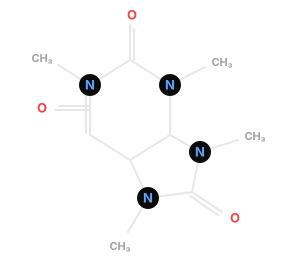
C₉H₁₂N₄O₃
224.22 g/mol
1,3,7,9-Tetramethyl-3,9-dihydro-1H-purine-2,6,8(7H)-trione
2309-49-1
Overview
Theacrine (1,3,7,9-tetramethyluric acid) is a purine alkaloid found primarily in the leaves of Camellia kucha, a unique tea plant native to Yunnan, China. Structurally related to caffeine, theacrine is believed to be biosynthesized from caffeine in the plant. What makes theacrine particularly interesting is its ability to provide stimulant-like effects — increased energy, focus, and motivation — while preliminary research suggests it may not lead to the same degree of tolerance or habituation seen with caffeine. Commercially available as TeaCrine®, theacrine has gained popularity in the nootropic and sports supplement communities as a longer-lasting, smoother alternative to caffeine.
Mechanism of Action
Theacrine appears to modulate both adenosinergic and dopaminergic pathways. Like caffeine, it acts as an antagonist at adenosine receptors, which may contribute to its wakefulness-promoting effects. However, theacrine also appears to activate dopamine D1 and D2 receptors, which may explain its mood-elevating and motivational effects. The combination of adenosine antagonism and dopaminergic activation may also contribute to the reduced tolerance buildup observed in animal studies, as the two pathways may provide complementary stimulation without the same degree of receptor desensitization.
Benefits & Evidence
Sustained Energy Without Tolerance
Research suggests theacrine provides energy and wakefulness effects similar to caffeine, but with less tolerance development over time. An 8-week study found no habituation to theacrine's effects at 300mg/day.
Cognitive Function Support
Preliminary evidence suggests theacrine may support attention and concentration, potentially through combined adenosinergic and dopaminergic mechanisms.
Anti-inflammatory Properties
Animal studies have demonstrated anti-inflammatory and analgesic effects of theacrine, potentially mediated through adenosine A1 and A2A receptor activity.
Dosage & Timing
100-300mg
1x daily
Morning, or 30-60 minutes before desired effect
100mg — 400mg
Note: Often stacked with caffeine at lower doses (e.g., 125mg theacrine + 150mg caffeine). Start at the lower end to assess tolerance. Effects may be more subtle than caffeine for habitual caffeine users.
Safety Profile
Side Effects
- Nausea at higher doses
- Restlessness
- Difficulty sleeping if taken late in the day
- Mild headache (uncommon)
Interactions
- Caffeine (may have synergistic effects; commonly combined)
- Other stimulants (additive stimulatory effects)
- MAO inhibitors (theoretical interaction via dopamine modulation)
Contraindications
- Pregnancy and breastfeeding (insufficient safety data)
- Severe anxiety disorders
- Cardiovascular conditions (use caution)
- Children (insufficient safety data)
References & Sources
A two-part approach to examine the effects of theacrine (TeaCrine®) supplementation on oxygen consumption, hemodynamic responses, and subjective measures of cognitive and psychometric parameters
Taylor L, Mumford P, Roberts M, et al.
Journal of Dietary Supplements (2016)
Found that 8 weeks of theacrine supplementation (300mg/day) did not result in habituation or desensitization of energizing effects.
DOI: 10.3109/19390211.2015.1007833 ↗Theacrine (1,3,7,9-tetramethyluric acid) — a natural stimulant and anti-depressant in preclinical models
Feduccia AA, Wang Y, Bhatt S, et al.
Chinese Medicine (2012)
Demonstrated theacrine's stimulant and antidepressant-like effects in rodent models, mediated through adenosinergic and dopaminergic systems.
DOI: 10.1186/1749-8546-7-9 ↗Theacrine, a special purine alkaloid with sedative and hypnotic properties from Cmellia assamica var. kucha in mice
Wang Y, Yang X, Zheng X, et al.
Journal of Food and Drug Analysis (2014)
Characterized theacrine's dose-dependent effects, with lower doses showing stimulant activity and higher doses showing sedative properties in mice.
DOI: 10.1016/j.jfda.2014.03.004 ↗Anti-inflammatory, immunomodulatory, and analgesic effects of theacrine — a purine alkaloid from Chinese tea
Sheng YY, Xiang J, Wang ZS, et al.
Food Research International (2014)
Demonstrated significant anti-inflammatory and analgesic effects of theacrine in animal models.
DOI: 10.1016/j.foodres.2014.06.018 ↗