Rhodiola Rosea
C₁₄H₂₀O₇
Also known as: Golden Root, Arctic Root, Roseroot, Rhodiola
Disclaimer: This information is for educational purposes only and is not intended as medical advice. Consult a healthcare professional before starting any supplement regimen.
Molecular Profile
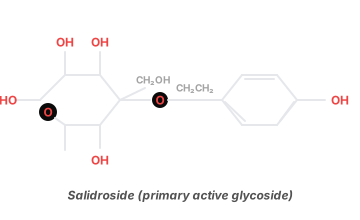
C₁₄H₂₀O₇
300.3 g/mol
(2R,3S,4S,5R,6R)-2-[4-(2-Hydroxyethyl)phenoxy]-6-(hydroxymethyl)oxane-3,4,5-triol (Salidroside)
10338-51-9
Overview
Rhodiola Rosea is a perennial flowering plant that thrives in cold, mountainous regions of Europe and Asia, including the Arctic. It has been used for centuries in traditional medicine systems of Scandinavia, Russia, and China as a tonic for fatigue, stress, and cognitive enhancement. The root contains over 140 active compounds, with salidroside and rosavins (rosavin, rosin, and rosarin) being the primary bioactive markers. Modern standardized extracts are typically calibrated to contain 3% rosavins and 1% salidroside. The molecular data shown represents salidroside, considered the most pharmacologically important active compound. Rhodiola has one of the strongest bodies of clinical evidence among adaptogens.
Mechanism of Action
Rhodiola Rosea exerts its adaptogenic effects through multiple mechanisms. It modulates the HPA axis and stress-response mediators, helping normalize cortisol and stress-activated protein kinases during chronic stress. Salidroside influences monoamine neurotransmitter levels by inhibiting MAO-A and COMT enzymes, which may increase available serotonin, dopamine, and norepinephrine in the brain. Rhodiola also activates AMPK (AMP-activated protein kinase), supporting cellular energy metabolism, and has been shown to upregulate neuroprotective proteins including Nrf2 and heat shock proteins. These combined actions contribute to its anti-fatigue, mood-enhancing, and cognitive-protective properties.
Benefits & Evidence
Stress Adaptation
As a well-characterized adaptogen, Rhodiola helps the body maintain homeostasis during stress. Clinical trials show reduced burnout symptoms, improved stress tolerance, and better stress-related biomarker profiles.
Mood & Mild Depression Support
Clinical evidence suggests Rhodiola may have antidepressant effects in mild to moderate depression, potentially through monoamine modulation. One RCT found it comparable to sertraline with fewer side effects.
Dosage & Timing
200-400mg
1-2x daily
Morning on an empty stomach; avoid late-day dosing due to mild stimulating effects
100mg — 600mg
Note: Use extracts standardized to 3% rosavins and 1% salidroside. Acute effects (anti-fatigue) can be felt within 30-60 minutes. Full adaptogenic benefits build over 2-3 weeks. Cycling may help maintain effectiveness.
Safety Profile
Side Effects
- Dizziness
- Dry mouth
- Jitteriness or restlessness
- Difficulty sleeping if taken late in the day
- Vivid dreams (uncommon)
Interactions
- Antidepressants (SSRIs, MAOIs — may have additive serotonergic effects)
- Stimulants (additive stimulatory effects)
- Blood pressure medications (may have additive effects)
- Diabetes medications (may lower blood sugar)
- Anticoagulants (theoretical interaction)
Contraindications
- Bipolar disorder (may induce mania in susceptible individuals)
- Pregnancy and breastfeeding
- Autoimmune conditions (may stimulate immune function)
- Concurrent MAOI use
References & Sources
A randomised, double-blind, placebo-controlled, parallel-group study of the standardised extract SHR-5 of the roots of Rhodiola rosea in the treatment of subjects with stress-related fatigue
Olsson EM, von Schéele B, Panossian AG
Planta Medica (2009)
Rhodiola SHR-5 576mg/day significantly improved symptoms of fatigue, attention, and cortisol response in stressed individuals over 28 days.
DOI: 10.1055/s-0028-1088346 ↗A double-blind, placebo-controlled pilot study of the stimulating and adaptogenic effect of Rhodiola rosea SHR-5 extract on the fatigue of students caused by stress during an examination period
Shevtsov VA, Zholus BI, Shervarly VI, et al.
Phytomedicine (2003)
Rhodiola 100mg/day improved physical fitness, mental fatigue, and neuro-motor test performance in medical students during examination stress.
DOI: 10.1078/094471103321659780 ↗Rhodiola rosea in stress induced fatigue — a double blind cross-over study of a standardized extract SHR-5 with a repeated low-dose regimen
Darbinyan V, Kteyan A, Panossian A, et al.
Phytomedicine (2000)
Rhodiola SHR-5 significantly improved cognitive functions (associative thinking, short-term memory, concentration) during fatigue and stress.
DOI: 10.1016/S0944-7113(00)80055-0 ↗The effects of Rhodiola rosea L. extract on anxiety, stress, cognition and other mood symptoms
Cropley M, Banks AP, Boyle J
Phytotherapy Research (2015)
Rhodiola 200mg twice daily for 14 days significantly reduced self-reported anxiety, stress, anger, confusion, and depression in mildly anxious participants.
DOI: 10.1002/ptr.5486 ↗Rhodiola rosea versus sertraline for major depressive disorder: a randomized placebo-controlled trial
Mao JJ, Xie SX, Zee J, et al.
Phytomedicine (2015)
Rhodiola showed less antidepressant efficacy than sertraline but significantly fewer side effects, suggesting a more favorable risk-to-benefit ratio for mild-moderate depression.
DOI: 10.1016/j.phymed.2015.01.010 ↗