Modafinil
C₁₅H₁₅NO₂S
Also known as: Provigil, Alertec, Modalert, Modavigil, 2-[(Diphenylmethyl)sulfinyl]acetamide
Disclaimer: This information is for educational purposes only and is not intended as medical advice. Consult a healthcare professional before starting any supplement regimen.
Molecular Profile
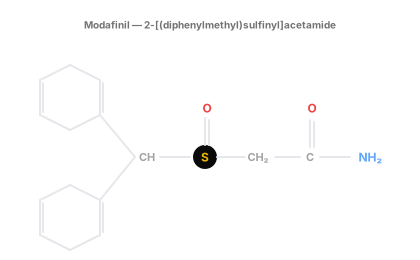
C₁₅H₁₅NO₂S
273.35 g/mol
2-[(Diphenylmethyl)sulfinyl]acetamide
68693-11-8
Overview
Modafinil is a wakefulness-promoting agent (a 'eugeroic') first developed in France in the 1970s and approved by the FDA in 1998 for excessive daytime sleepiness due to narcolepsy. It was subsequently approved for shift-work sleep disorder and obstructive sleep apnea. Unlike classical stimulants (amphetamines, methylphenidate), modafinil produces minimal peripheral sympathomimetic effects at therapeutic doses, does not typically cause the euphoria and post-dose crash of amphetamines, and has substantially lower abuse potential — though it is a Schedule IV controlled substance in the United States. Modafinil has become widely studied as a cognitive enhancer in healthy, non-sleep-deprived individuals, where systematic reviews confirm consistent benefits on attention, executive function, and complex problem-solving. It is available by prescription only in most jurisdictions.
Mechanism of Action
Modafinil's mechanism is pharmacologically atypical and not fully characterized. Its best-established action is weak-to-moderate inhibition of the dopamine transporter (DAT), which raises extracellular dopamine — particularly in the striatum and nucleus accumbens — and is considered necessary for its wakefulness effects (D1/D2 receptor-dependent in knockout studies). Secondary mechanisms include inhibition of the norepinephrine transporter (NET), activation of orexin/hypocretin neurons in the lateral hypothalamus, elevated histaminergic activity in the tuberomammillary nucleus, and modulation of glutamate and GABA balance in cortical circuits. This broad, distributed action on arousal and executive-control systems — rather than a single high-affinity receptor — likely explains modafinil's relatively clean side-effect profile compared to classical stimulants.
Benefits & Evidence
Wakefulness & Fatigue Resistance
Modafinil reliably increases wakefulness and reduces fatigue in narcolepsy, shift-work sleep disorder, and obstructive sleep apnea, as well as in sleep-deprived healthy adults. This is the most robust finding in the literature and the basis for FDA approval.
Executive Function & Complex Cognition
A systematic review (Battleday & Brem 2015) concluded that in non-sleep-deprived healthy adults, modafinil consistently improves attention, executive function, learning, and planning — with larger effects on more complex, demanding tasks.
Working Memory & Planning
Turner 2003 demonstrated 200mg modafinil improved digit-span, visual pattern recognition, spatial planning, and stop-signal reaction time versus placebo in healthy young adults, without affecting mood or self-reported alertness excessively.
Task Enjoyment & Motivation
Müller 2013 found modafinil increased task enjoyment on a cognitive test battery and improved performance on tasks requiring motivated, effortful processing — an effect likely mediated by striatal dopamine.
Dosage & Timing
100–200mg
1x daily (morning), or split dose with second dose before 12pm
Morning only — modafinil's 12–15 hour half-life means late-day dosing reliably disrupts nighttime sleep.
50mg — 400mg
Note: 200mg/day is the FDA-approved adult dose for narcolepsy; most off-label cognitive enhancement studies used 100–200mg. Split dosing (e.g., 100mg on waking + 100mg at ~11am) is sometimes preferred to smooth plasma levels. Tolerance to wakefulness effects is minimal at standard doses but can occur with daily chronic use — many users cycle modafinil (e.g., 5 days on, 2 days off). Prescription required in most jurisdictions.
Safety Profile
Side Effects
- Headache (most common — ~30% of users, typically mild-to-moderate)
- Insomnia (especially if dosed after noon)
- Nausea
- Anxiety or jitteriness
- Dry mouth, reduced appetite
- Rare but serious: Stevens-Johnson syndrome, toxic epidermal necrolysis, DRESS — require immediate discontinuation if rash develops
- Rare psychiatric effects: mania, psychosis, suicidal ideation (screen for bipolar diathesis)
Interactions
- Hormonal contraceptives (modafinil induces CYP3A4; efficacy of estrogen-containing contraceptives may be reduced — use backup contraception for 1+ months after discontinuation)
- Warfarin (altered anticoagulation — monitor INR)
- Cyclosporine, theophylline (reduced levels)
- TCAs, SSRIs, MAOIs (additive CNS effects; caution with MAOIs)
- Alcohol (unpredictable effects; avoid)
Contraindications
- History of severe skin reaction to modafinil or armodafinil
- Left ventricular hypertrophy or recent myocardial infarction (cardiovascular risk)
- Severe anxiety disorders, history of psychosis or mania
- Pregnancy and breastfeeding (insufficient safety data; some evidence of fetal risk)
- Children (safety and efficacy not established)
References & Sources
Modafinil for cognitive neuroenhancement in healthy non-sleep-deprived subjects: A systematic review
Battleday RM, Brem AK
European Neuropsychopharmacology (2015)
Systematic review of 24 studies concluding modafinil reliably enhances attention, executive function, learning, and decision-making in healthy non-sleep-deprived adults, with larger benefits on complex tasks.
DOI: 10.1016/j.euroneuro.2015.07.028 ↗Cognitive enhancing effects of modafinil in healthy volunteers
Turner DC, Robbins TW, Clark L, Aron AR, Dowson J, Sahakian BJ
Psychopharmacology (2003)
Placebo-controlled double-blind crossover: 200mg modafinil improved digit span, visual pattern recognition, spatial planning, and stop-signal reaction time in 60 healthy young males.
DOI: 10.1007/s00213-002-1250-8 ↗Modafinil: a review of neurochemical actions and effects on cognition
Minzenberg MJ, Carter CS
Neuropsychopharmacology (2008)
Comprehensive review of modafinil's pharmacology — dopamine/norepinephrine transporter inhibition, orexin and histaminergic activation — and its consistent cognitive effects in sleep-deprived and healthy populations.
DOI: 10.1038/sj.npp.1301534 ↗Effects of modafinil on non-verbal cognition, task enjoyment and creative thinking in healthy volunteers
Müller U, Rowe JB, Rittman T, Lewis C, Robbins TW, Sahakian BJ
Neuropharmacology (2013)
200mg modafinil improved performance on complex planning and working-memory tasks and increased task enjoyment; no effect on creative thinking measures.
DOI: 10.1016/j.neuropharm.2012.07.009 ↗Cognitive effects of modafinil in student volunteers may depend on IQ
Randall DC, Shneerson JM, File SE
Pharmacology Biochemistry and Behavior (2005)
Crossover study suggesting modafinil's cognitive benefits in healthy students depend on baseline IQ, with larger improvements in lower-performing subjects on some tasks.
DOI: 10.1016/j.pbb.2005.07.019 ↗