Lion's Mane
C₂₅H₃₄O₆
Also known as: Hericium erinaceus, Yamabushitake, Houtou, Monkey Head Mushroom, Bearded Tooth Mushroom
Disclaimer: This information is for educational purposes only and is not intended as medical advice. Consult a healthcare professional before starting any supplement regimen.
Molecular Profile
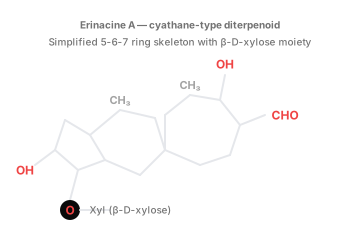
C₂₅H₃₄O₆
430.54 g/mol
Erinacine A — a cyathane-type diterpenoid representative of the BBB-penetrating NGF-inducing compounds in Hericium erinaceus mycelium
165102-27-6
Overview
Lion's Mane (Hericium erinaceus) is an edible, cascading-tooth mushroom that grows on hardwood trees across the Northern Hemisphere. It has a long history of culinary and medicinal use in East Asia, where it is called Yamabushitake in Japan and Houtou in China. Its modern nootropic reputation rests on two families of bioactive compounds: hericenones (primarily in the fruiting body) and erinacines (primarily in the mycelium). Both have been shown to stimulate the synthesis of nerve growth factor (NGF) in vitro. Erinacines are of particular interest because they cross the blood-brain barrier — erinacine A-enriched mycelium has demonstrated cognitive benefits in both preclinical Alzheimer's models and small human trials. The molecular data shown represents erinacine A, the most pharmacologically characterized neurotrophic compound in the species. Standardized commercial products are typically labeled by either extract ratio (e.g., 8:1) or β-glucan content, and the hericenone vs. erinacine balance depends on whether the product is fruiting-body-only or includes mycelium.
Mechanism of Action
Lion's Mane's neurotrophic effects are mediated primarily through stimulation of nerve growth factor (NGF) and brain-derived neurotrophic factor (BDNF) synthesis in the brain. Hericenones and erinacines upregulate NGF mRNA expression in astrocytes and neuronal cells, which in turn supports the survival, growth, and differentiation of cholinergic neurons — particularly in the hippocampus and basal forebrain. Erinacine A, being lipophilic and BBB-permeable, has been shown in rodent models to increase catecholamine and BDNF levels in the hippocampus and to reduce amyloid-β plaque burden in Alzheimer's disease models. Additional effects include modulation of neuroinflammation (reduced microglial activation), antioxidant activity via Nrf2 pathway induction, and possible remyelination support. These mechanisms are structural/plastic rather than acute, which is consistent with the multi-week onset observed in clinical trials.
Benefits & Evidence
Cognitive Function in Mild Cognitive Impairment
In a 16-week RCT (Mori 2009), older adults with MCI taking 3g/day Lion's Mane powder showed significantly improved scores on the revised Japanese Hasegawa Dementia Scale versus placebo. Benefits diminished 4 weeks after discontinuation.
NGF & Neurotrophic Support
Hericenones and erinacines have been repeatedly shown in cell and animal studies to stimulate NGF synthesis, support cholinergic neuron survival, and enhance neurite outgrowth — making Lion's Mane unique among nootropics as a genuine neurotrophic agent.
Mood Support
A 4-week RCT in menopausal women (Nagano 2010) found Lion's Mane cookies reduced depression and anxiety scores on the CES-D and ICSI versus placebo, suggesting mood benefits independent of the longer-timeline cognitive effects.
Early Alzheimer's Disease Support
A 49-week double-blind RCT of erinacine A-enriched mycelium (Li 2020) in mild Alzheimer's patients showed improvement on instrumental ADL and slower CASI decline versus placebo, with a favorable safety profile.
Dosage & Timing
500mg–3g (extract, standardized for β-glucans or hericenones/erinacines)
1–2x daily
With food; consistency over 4–12 weeks matters more than precise timing.
500mg — 3000mg
Note: Clinical trials have used doses from 1g fruiting-body powder × 3/day (Mori 2009) to erinacine A-enriched mycelium at 1.05g/day (Li 2020). Fruiting-body-only products are rich in hericenones; mycelium-containing products add erinacines. Prefer products that specify the extraction method, β-glucan content, and whether they are fruiting body, mycelium, or both.
Safety Profile
Side Effects
- Generally well-tolerated
- Mild gastrointestinal upset
- Skin itching (uncommon — may reflect mild immune-activating effects)
- Allergic reactions in individuals with mushroom allergies (rare but possible)
Interactions
- Anticoagulants / antiplatelets (theoretical — Lion's Mane may have mild antiplatelet activity)
- Diabetes medications (Lion's Mane may slightly lower blood glucose)
- Immunosuppressants (possible attenuation via β-glucan immune modulation)
Contraindications
- Mushroom allergy
- Pregnancy and breastfeeding (insufficient safety data)
- Scheduled surgery (discontinue ~2 weeks prior)
References & Sources
Improving effects of the mushroom Yamabushitake (Hericium erinaceus) on mild cognitive impairment: a double-blind placebo-controlled clinical trial
Mori K, Inatomi S, Ouchi K, Azumi Y, Tuchida T
Phytotherapy Research (2009)
Sixteen-week double-blind RCT in 30 adults aged 50–80 with MCI: 1g Lion's Mane powder × 3/day significantly improved cognitive function scale scores; benefits diminished 4 weeks after discontinuation.
DOI: 10.1002/ptr.2634 ↗Hericenones C, D and E, stimulators of nerve growth factor (NGF)-synthesis, from the mushroom Hericium erinaceum
Kawagishi H, Ando M, Sakamoto H, et al.
Tetrahedron Letters (1991)
Original isolation and structural characterization of hericenones C, D, and E as NGF-synthesis-stimulating compounds from Hericium erinaceus fruiting body.
DOI: 10.1016/0040-4039(91)80041-3 ↗Reduction of depression and anxiety by 4 weeks Hericium erinaceus intake
Nagano M, Shimizu K, Kondo R, et al.
Biomedical Research (2010)
Four-week trial in 30 menopausal women found Lion's Mane cookies reduced depression (CES-D) and indefinite complaints (ICSI) versus placebo.
DOI: 10.2220/biomedres.31.231 ↗Prevention of Early Alzheimer's Disease by Erinacine A-Enriched Hericium erinaceus Mycelia Pilot Double-Blind Placebo-Controlled Study
Li IC, Chang HH, Lin CH, Chen WP, Lu TH, Lee LY, et al.
Frontiers in Aging Neuroscience (2020)
Forty-nine-week RCT in mild Alzheimer's patients: 1.05g/day erinacine A-enriched mycelium improved instrumental ADL and slowed CASI decline versus placebo with favorable safety.
DOI: 10.3389/fnagi.2020.00155 ↗The Neuroprotective Properties of Hericium erinaceus in Glutamate-Damaged Differentiated PC12 Cells and an Alzheimer's Disease Mouse Model
Zhang J, An S, Hu W, et al.
International Journal of Molecular Sciences (2016)
Preclinical study demonstrating Hericium erinaceus extract protected cells from glutamate excitotoxicity and improved cognitive function and neurogenesis in an APP/PS1 Alzheimer's mouse model.
DOI: 10.3390/ijms17111810 ↗