L-Theanine
C₇H₁₄N₂O₃
Also known as: Theanine, N-Ethyl-L-glutamine, γ-Glutamylethylamide, L-Gamma-glutamylethylamide
Disclaimer: This information is for educational purposes only and is not intended as medical advice. Consult a healthcare professional before starting any supplement regimen.
Molecular Profile
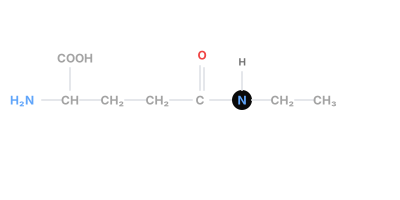
C₇H₁₄N₂O₃
174.2 g/mol
(2S)-2-Amino-4-(ethylamino)-4-oxobutanoic acid
3081-61-6
Overview
L-Theanine is a non-proteinogenic amino acid structurally related to glutamate and glutamine. It is found in significant quantities only in Camellia sinensis (green, black, and white tea) and in the edible mushroom Boletus badius, and is largely responsible for the characteristic umami taste of brewed tea. Despite its chemical similarity to the excitatory neurotransmitter glutamate, L-theanine produces a distinctly calming effect. It is readily absorbed from the small intestine, crosses the blood-brain barrier, and reaches peak plasma concentrations within about 30–50 minutes after oral administration. L-Theanine has become one of the most widely studied nootropic amino acids, largely because of its well-documented synergy with caffeine — the combination consistently produces faster reaction times, better task-switching, and reduced anxiety than either compound alone.
Mechanism of Action
L-Theanine modulates several key neurotransmitter systems. It binds weakly to glutamate receptors (including AMPA, kainate, and NMDA subtypes) as a partial agonist/antagonist, which is thought to temper excitatory glutamatergic signaling. It increases cortical GABA levels, raises dopamine and serotonin in selected brain regions in rodents, and reliably elevates alpha-wave (8–13 Hz) power on the human EEG — a signature pattern associated with a state of relaxed alertness. Additional downstream effects may include inhibition of glutamate reuptake via blockade of certain glutamate transporters and a blunting of the sympathetic stress response, which together explain why L-theanine lowers subjective and physiological markers of acute stress without producing sedation.
Benefits & Evidence
Sleep Quality Support
Because L-theanine reduces arousal without inducing drowsiness, it has been shown to improve sleep quality and reduce nighttime wake-ups when taken in the evening, particularly in individuals with elevated baseline anxiety.
Dosage & Timing
100–200mg
1–2x daily
With or without caffeine; 30–45 minutes before cognitive tasks. Can also be taken 30–60 minutes before bed for sleep support.
50mg — 400mg
Note: The 1:2 caffeine-to-theanine ratio (e.g., 100mg caffeine + 200mg theanine) is the most well-studied stack. Effects are acute — no loading period required. Generally well-tolerated even at doses up to 900mg/day in short-term trials.
Safety Profile
Side Effects
- Mild headache (uncommon)
- Lightheadedness at high doses
- Gastrointestinal discomfort (rare)
- Slightly lower blood pressure (usually not clinically significant)
Interactions
- Caffeine (synergistic — this is the intended interaction)
- Antihypertensive medications (additive mild blood-pressure-lowering effect)
- Stimulant medications (may blunt stimulant-associated jitteriness)
Contraindications
- Pregnancy and breastfeeding (insufficient safety data)
- Hypotension (use caution)
- Children (limited safety data; consult a clinician)
References & Sources
L-theanine, a natural constituent in tea, and its effect on mental state
Nobre AC, Rao A, Owen GN
Asia Pacific Journal of Clinical Nutrition (2008)
EEG study showing 50mg L-theanine significantly increased alpha-wave activity in the resting brain state, consistent with a state of relaxed alertness.
Effects of L-Theanine Administration on Stress-Related Symptoms and Cognitive Functions in Healthy Adults: A Randomized Controlled Trial
Hidese S, Ogawa S, Ota M, et al.
Nutrients (2019)
Four-week RCT in 30 healthy adults: 200mg/day L-theanine improved stress-related symptoms, sleep, and verbal fluency / executive-function measures versus placebo.
DOI: 10.3390/nu11102362 ↗The effects of L-theanine, caffeine and their combination on cognition and mood
Haskell CF, Kennedy DO, Milne AL, Wesnes KA, Scholey AB
Biological Psychology (2008)
Acute crossover trial showing the combination of 97mg L-theanine + 40mg caffeine produced faster, more accurate attention and reduced task-related tiredness versus either agent alone.
DOI: 10.1016/j.biopsycho.2007.09.008 ↗The combined effects of L-theanine and caffeine on cognitive performance and mood
Owen GN, Parnell H, De Bruin EA, Rycroft JA
Nutritional Neuroscience (2008)
Confirmed improved accuracy on attention-switching tasks and reduced susceptibility to distracting information from 50mg caffeine + 100mg L-theanine versus placebo.
DOI: 10.1179/147683008X301513 ↗L-Theanine reduces psychological and physiological stress responses
Kimura K, Ozeki M, Juneja LR, Ohira H
Biological Psychology (2007)
200mg L-theanine attenuated heart-rate and salivary immunoglobulin-A responses to an acute mental-arithmetic stressor in 12 healthy participants.
DOI: 10.1016/j.biopsycho.2006.06.006 ↗Effects of chronic L-theanine administration in patients with major depressive disorder: an open-label study
Hidese S, Ota M, Wakabayashi C, et al.
Acta Neuropsychiatrica (2017)
Eight-week open-label trial: 250mg/day L-theanine as adjunct therapy improved depressive, anxiety, and sleep disturbance scores in patients with MDD, with improvements on verbal-memory and executive-function tests.
DOI: 10.1017/neu.2016.33 ↗