Creatine Monohydrate
C₄H₁₁N₃O₃
Also known as: Creatine, N-Methylguanidinoacetic acid monohydrate, N-Amidinosarcosine monohydrate, Creatine H₂O
Disclaimer: This information is for educational purposes only and is not intended as medical advice. Consult a healthcare professional before starting any supplement regimen.
Molecular Profile
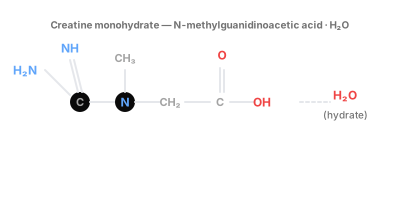
C₄H₁₁N₃O₃
149.15 g/mol
2-[Carbamimidoyl(methyl)amino]acetic acid monohydrate
6020-87-7
Overview
Creatine is a naturally occurring nitrogenous compound synthesized in the liver, kidneys, and pancreas from the amino acids glycine, arginine, and methionine. About 95% of the body's creatine pool is stored in skeletal muscle as phosphocreatine; the remaining ~5% is distributed in the brain, heart, and other tissues. Daily creatine requirements (~1–3g) are met by a combination of endogenous synthesis and dietary intake from meat, fish, and dairy. Creatine monohydrate is the most extensively researched and cost-effective supplemental form, with hundreds of RCTs confirming its safety and ergogenic efficacy. More recently, a substantial body of cognitive research has established creatine as a legitimate nootropic — particularly in states of metabolic stress such as sleep deprivation, hypoxia, and vegetarianism, where baseline brain creatine stores are lower. The molecular data shown represents the monohydrate form, which is chemically identical to anhydrous creatine plus one water molecule of crystallization.
Mechanism of Action
In neurons and muscle cells, creatine is phosphorylated by creatine kinase to phosphocreatine (PCr), which serves as a rapidly mobilizable reservoir of high-energy phosphate bonds. When cellular ATP demand spikes, PCr donates its phosphate group to ADP, regenerating ATP on a sub-second timescale. This phosphocreatine–ATP shuttle is especially relevant in the brain under conditions of high cognitive load, metabolic stress, or sleep deprivation, where supplementation raises brain PCr concentrations by ~5–9% (measurable by ³¹P-MRS). Secondary mechanisms include reduced neuronal mitochondrial oxidative stress, modulation of glutamatergic and dopaminergic signaling, and membrane-stabilizing effects. The cognitive benefits are largest when baseline brain creatine is low (vegetarians, sleep-deprived individuals, older adults) and smaller — though still measurable — in rested, well-nourished omnivores.
Benefits & Evidence
Working Memory & Reasoning
Rae 2003 showed 5g/day creatine for 6 weeks improved Raven's Advanced Progressive Matrices and backward digit span in young vegetarian adults. Meta-analysis confirms small-to-moderate memory improvements in healthy adults, with larger effects in older adults.
Cognition Under Sleep Deprivation
McMorris 2006 demonstrated 20g/day creatine for 7 days (then sleep-deprivation protocol) preserved cognitive performance on complex tasks, balance, and mood during 24-hour sleep deprivation versus placebo.
Cellular Energy & Brain ATP
³¹P-MR spectroscopy studies confirm oral creatine supplementation raises brain phosphocreatine, supporting the hypothesized energetic basis for its cognitive effects. This is the most mechanistically grounded mechanism of any current nootropic.
Ergogenic / Physical Performance
Decades of RCTs and several meta-analyses show 3–5g/day creatine monohydrate improves repeated-bout maximal effort, strength gains, and lean mass in trained and untrained populations. This is the most-validated ergogenic supplement.
Cognition in Older Adults
McMorris 2007 showed creatine supplementation in healthy elderly participants improved random number generation, forward/backward spatial recall, and long-term memory versus placebo — a population where endogenous creatine synthesis declines.
Dosage & Timing
3–5g daily
1x daily (maintenance); loading optional
Any time of day; consistency matters more than timing. Optional loading phase of 20g/day (split 4×5g) for 5–7 days saturates brain/muscle stores faster; otherwise 3–5g/day reaches saturation in ~3–4 weeks.
3mg — 20mg
Note: Take with water; carbohydrate or protein co-ingestion may modestly improve uptake but is not required. For cognitive effects, daily consistency over 2–4+ weeks is key. Cognitive dosing in trials has ranged from 5g to 20g — 5g/day is a sensible long-term dose for most adults. Higher doses (20g/day) have been studied short-term for sleep-deprivation and exercise-induced metabolic stress contexts.
Safety Profile
Side Effects
- Mild weight gain from intramuscular water retention (~1–2 kg in first weeks)
- Gastrointestinal discomfort — most often from large single doses; mitigated by splitting or loading over multiple meals
- Mild transient muscle cramping (largely anecdotal; RCTs do not consistently show increased cramping risk)
Interactions
- Caffeine at very high doses (mixed evidence — some studies suggest attenuation of ergogenic effects; practical effect is small)
- Nephrotoxic drugs (theoretical caution — creatine raises serum creatinine without harming kidney function; affects lab interpretation, not physiology)
Contraindications
- Pre-existing kidney disease (consult a clinician; standard doses appear safe in healthy kidneys, but use in renal impairment requires supervision)
- Pregnancy and breastfeeding (limited data, though emerging evidence is favorable — consult a clinician)
References & Sources
Oral creatine monohydrate supplementation improves brain performance: a double-blind, placebo-controlled, cross-over trial
Rae C, Digney AL, McEwan SR, Bates TC
Proceedings of the Royal Society B: Biological Sciences (2003)
Cross-over RCT in 45 young vegetarian adults: 5g/day creatine for 6 weeks significantly improved scores on Raven's APM and backward digit span — the first clear evidence of cognitive benefit in healthy adults.
DOI: 10.1098/rspb.2003.2492 ↗Effect of creatine supplementation and sleep deprivation, with mild exercise, on cognitive and psychomotor performance, mood state, and plasma concentrations of catecholamines and cortisol
McMorris T, Harris RC, Swain J, et al.
Psychopharmacology (2006)
Creatine (20g/day × 7 days) attenuated cognitive, mood, and balance decrements during 24-hour sleep deprivation versus placebo.
DOI: 10.1007/s00213-005-0269-z ↗Beyond muscle: the effects of creatine supplementation on brain creatine, cognitive processing, and traumatic brain injury
Dolan E, Gualano B, Rawson ES
European Journal of Sport Science (2019)
Comprehensive review of creatine's effects on brain creatine content, cognitive processing under metabolic stress, and neuroprotection after TBI.
DOI: 10.1080/17461391.2018.1500644 ↗Effects of creatine supplementation on memory in healthy individuals: a systematic review and meta-analysis of randomized controlled trials
Prokopidis K, Giannos P, Triantafyllidis KK, Kechagias KS, Forbes SC, Candow DG
Nutrition Reviews (2023)
Meta-analysis concluding creatine supplementation improves memory performance in healthy individuals, with larger effect sizes in older adults.
DOI: 10.1093/nutrit/nuac064 ↗Creatine supplementation and cognitive performance in elderly individuals
McMorris T, Mielcarz G, Harris RC, Swain JP, Howard A
Aging, Neuropsychology, and Cognition (2007)
Creatine supplementation (20g/day × 7 days then 5g/day) improved random number generation, forward/backward digit recall, and long-term memory in healthy older adults.
DOI: 10.1080/13825580600788100 ↗