Ashwagandha
C₂₈H₃₈O₆
Also known as: Withania somnifera, KSM-66, Sensoril, Indian Ginseng, Winter Cherry
Disclaimer: This information is for educational purposes only and is not intended as medical advice. Consult a healthcare professional before starting any supplement regimen.
Molecular Profile
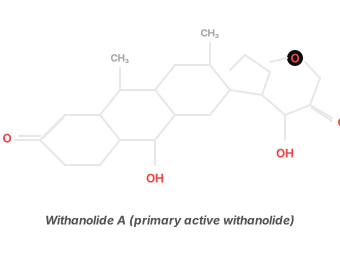
C₂₈H₃₈O₆
470.6 g/mol
Withanolide A — a steroidal lactone representative of the primary active compound class in Withania somnifera
32911-62-9
Overview
Ashwagandha (Withania somnifera) is one of the most important herbs in Ayurveda, the traditional Indian system of medicine, where it has been used for over 3,000 years as a Rasayana (rejuvenating tonic). The root extract contains a complex mixture of bioactive compounds, with withanolides being the primary pharmacologically active constituents. Modern standardized extracts like KSM-66 (standardized to 5% withanolides from root only) and Sensoril (standardized from both root and leaf) have enabled consistent dosing in clinical research. Ashwagandha is classified as an adaptogen — a substance that helps the body resist and adapt to various forms of stress. Note: The molecular data shown represents Withanolide A, one of the key active withanolides; ashwagandha's effects come from a complex of multiple bioactive compounds.
Mechanism of Action
Ashwagandha's adaptogenic effects involve multiple mechanisms. The withanolides modulate the hypothalamic-pituitary-adrenal (HPA) axis, helping normalize cortisol secretion during chronic stress. They also interact with GABAergic signaling, which may underlie the anxiolytic effects — withanolides have been shown to mimic GABA activity at GABA-A receptors. Additionally, ashwagandha exhibits antioxidant properties, reduces inflammatory markers (NF-κB pathway modulation), and may enhance serotonergic signaling. For cognitive benefits, ashwagandha appears to support acetylcholine signaling by inhibiting acetylcholinesterase and may promote neuronal regeneration through BDNF modulation.
Benefits & Evidence
Anxiety Reduction
A systematic review of multiple RCTs found ashwagandha extract significantly reduced anxiety scores on validated scales (HAM-A, DASS) compared to placebo, with effect sizes comparable to some pharmaceutical interventions.
Cognitive Function & Memory
Research suggests ashwagandha may improve attention, information processing speed, and both immediate and general memory, possibly through cholinergic and antioxidant mechanisms.
Physical Performance & Strength
An RCT in healthy adults performing resistance training found ashwagandha supplementation significantly improved muscle strength, recovery, and body composition compared to placebo.
Sleep Quality Improvement
Clinical trials show ashwagandha may improve sleep quality, reduce sleep onset latency, and enhance overall sleep satisfaction, particularly in stressed individuals.
Dosage & Timing
300-600mg
1-2x daily
Morning and/or evening with food; for sleep, take in the evening
300mg — 600mg
Note: Use standardized extracts (KSM-66 at 5% withanolides or Sensoril). Effects typically build over 2-4 weeks of consistent use. Cycling (e.g., 8 weeks on, 2-4 weeks off) is commonly recommended though not firmly evidence-based.
Safety Profile
Side Effects
- Gastrointestinal upset (nausea, diarrhea)
- Drowsiness (especially at higher doses)
- Headache
- Thyroid hormone changes with long-term use (may increase T3/T4)
- Rare: liver toxicity reported in isolated cases
Interactions
- Thyroid medications (ashwagandha may increase thyroid hormones)
- Immunosuppressants (ashwagandha may stimulate immune function)
- Sedatives and benzodiazepines (additive sedation)
- Diabetes medications (may lower blood sugar)
- Blood pressure medications (may have additive hypotensive effects)
Contraindications
- Pregnancy (may have abortifacient properties)
- Autoimmune conditions (may stimulate immune activity)
- Thyroid disorders (may alter thyroid hormone levels)
- Nightshade allergy (Withania is in the Solanaceae family)
- Upcoming surgery (discontinue 2 weeks before)
References & Sources
A prospective, randomized double-blind, placebo-controlled study of safety and efficacy of a high-concentration full-spectrum extract of ashwagandha root in reducing stress and anxiety in adults
Chandrasekhar K, Kapoor J, Anishetty S
Indian Journal of Psychological Medicine (2012)
300mg KSM-66 twice daily for 60 days reduced stress (44% reduction on PSS scale) and cortisol levels (27.9% reduction) vs placebo.
DOI: 10.4103/0253-7176.106022 ↗Adaptogenic and anxiolytic effects of ashwagandha root extract in healthy adults: a double-blind, randomized, placebo-controlled clinical study
Salve J, Pate S, Debnath K, Langade D
Cureus (2019)
Ashwagandha 250-600mg/day significantly reduced perceived stress, serum cortisol, and improved sleep quality over 8 weeks.
DOI: 10.7759/cureus.6466 ↗An alternative treatment for anxiety: a systematic review of human trial results reported for the Ayurvedic herb ashwagandha (Withania somnifera)
Pratte MA, Nanavati KB, Young V, Morley CP
Journal of Alternative and Complementary Medicine (2014)
Systematic review of 5 RCTs found ashwagandha consistently and significantly improved anxiety outcomes compared to placebo.
DOI: 10.1089/acm.2014.0177 ↗Examining the effect of Withania somnifera supplementation on muscle strength and recovery: a randomized controlled trial
Wankhede S, Langade D, Joshi K, Sinha SR, Bhattacharyya S
Journal of the International Society of Sports Nutrition (2015)
Ashwagandha 600mg/day with resistance training significantly increased muscle strength and size, and reduced body fat percentage vs placebo.
DOI: 10.1186/s12970-015-0104-9 ↗Efficacy and safety of ashwagandha (Withania somnifera) root extract in insomnia and anxiety: a double-blind, randomized, placebo-controlled study
Langade D, Kanchi S, Salve J, Debnath K, Ambegaokar D
Cureus (2019)
Ashwagandha 300mg twice daily significantly improved sleep quality, sleep onset latency, and overall well-being in adults with insomnia.
DOI: 10.7759/cureus.5797 ↗